Generative study: To know the JogjaKita’s user behavior and problem

Generative study: To know the JogjaKita’s user behavior and problem

Role

Role :

UX Researcher

Platform

Platform :

Android

Timeline

Timeline :

May - June 2022

Held

Role :

Online & Offline

WHAT HAVE I DONE, SPECIFICALLY

With my team, I was creating the research plan, conducted customer interviews (alternate with my team), and analyzed data into findings and recommendations for our stakeholders.

WHAT HAVE I DONE, SPECIFICALLY

With my team, I was creating the research plan, conducted customer interviews (alternate with my team), and analyzed data into findings and recommendations for our stakeholders.

Role :

UX Researcher

Platform :

Android

Timeline :

May - June 2022

Role :

Online & Offline

Summary

Summary

Stakeholders (C-level) asked us to enhance JogjaKita, but there was no user-centered data available. Utilizing survey user interview, usability testing techniques, we investigated users' needs, pain points, and discovered the behaviors of JogjaKita's users. We identified two personas with distinct behaviors and backgrounds. Some findings were transformed into insights related to complaints, covering UI/UX, marketing, JogjaKita's partners (merchants and drivers), and so on. These insights can later serve as a reference for JogjaKita's improvement.

BACKGROUND

JogjaKita is a ride-hailing app exclusively serving Jogja. Despite operating for nearly two years, its focus has been primarily on business development, with the user experience taking a backseat. The goal is to gain a deeper comprehension of users, their journey patterns, and collect insights to guide more effective actions.

RESEARCH OBJECTIVE

OBJECTIVE 2

Understanding the users

Understanding the behavior and user journey of JogjaKita’s users when using JogjaKita in daily life

OBJECTIVE 2

Know the user needs & pain points

Get feedback and user pain points while using JogjaKita’s service.

RESEARCH GOALS

GOAL 1

Personas & User Journey of users

Envision customer experiences and challenges through Personas and user journey mapping.

GOAL 2

Insight for actionable strategies

Offer an insightful statement for actionable strategies for the Jogjakita Team.

RESEARCH METHOD

Since we strive to understand user feedback, pain points, and problem areas, we conducted…

In-depth Interviews and usability testing existing app.

Just so you know, this research is an ongoing process stemming from survey analysis. Information from user interviews, user satisfaction & NPS, along with brief feedback, has been gathered during the survey phase.

RECRUITING PARTICIPANTS

  • Male and Female

  • Age 20 - 50 years old

  • Use JogjaKita or have used JogjaKita

😭But we had some obtacles😭

😭But we had some obtacles😭

Participant over 30 years old who took part in online interviews couldn't perform short usability testing due to challenges in screen sharing (user lacking tech skills) so we didn't carry out usability testing with the current app to understand user behaviors and pain points when using JogjaKita, from opening the app to placing an order.
Process raw data, then categorized into an affinity diagram

My team and I synthesize the findings from interview data and small-scale usability tests of users into an affinity diagram. Some of the grouped information we gathered was participant demographics, user demands daily ride-hailing, participant cognizance upon JogjaKita discovery, feedback on utilizing JogjaKita services, and challenges faced while using JogjaKita. Note, I did not show up all data here such as user demographics because of privacy.
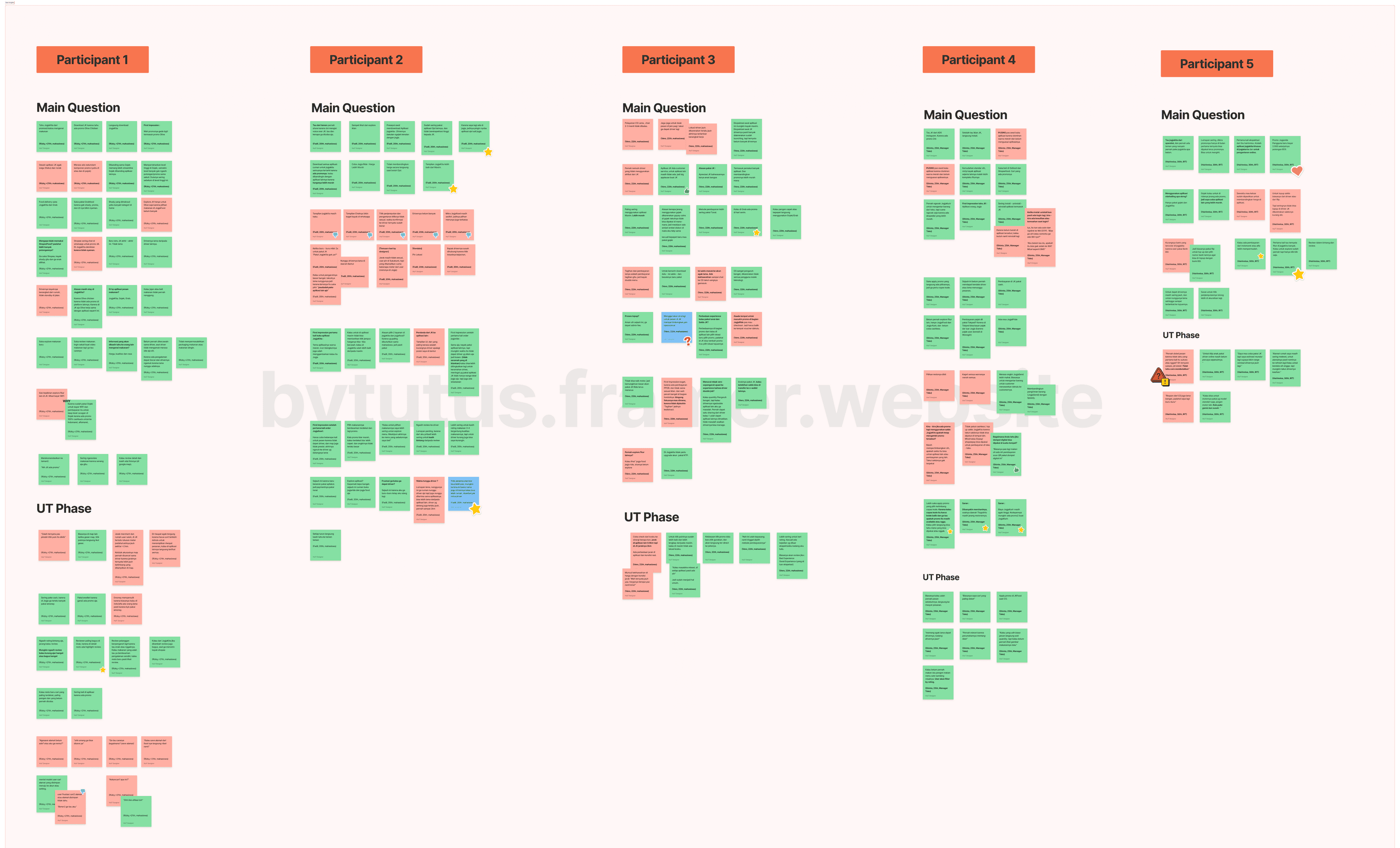
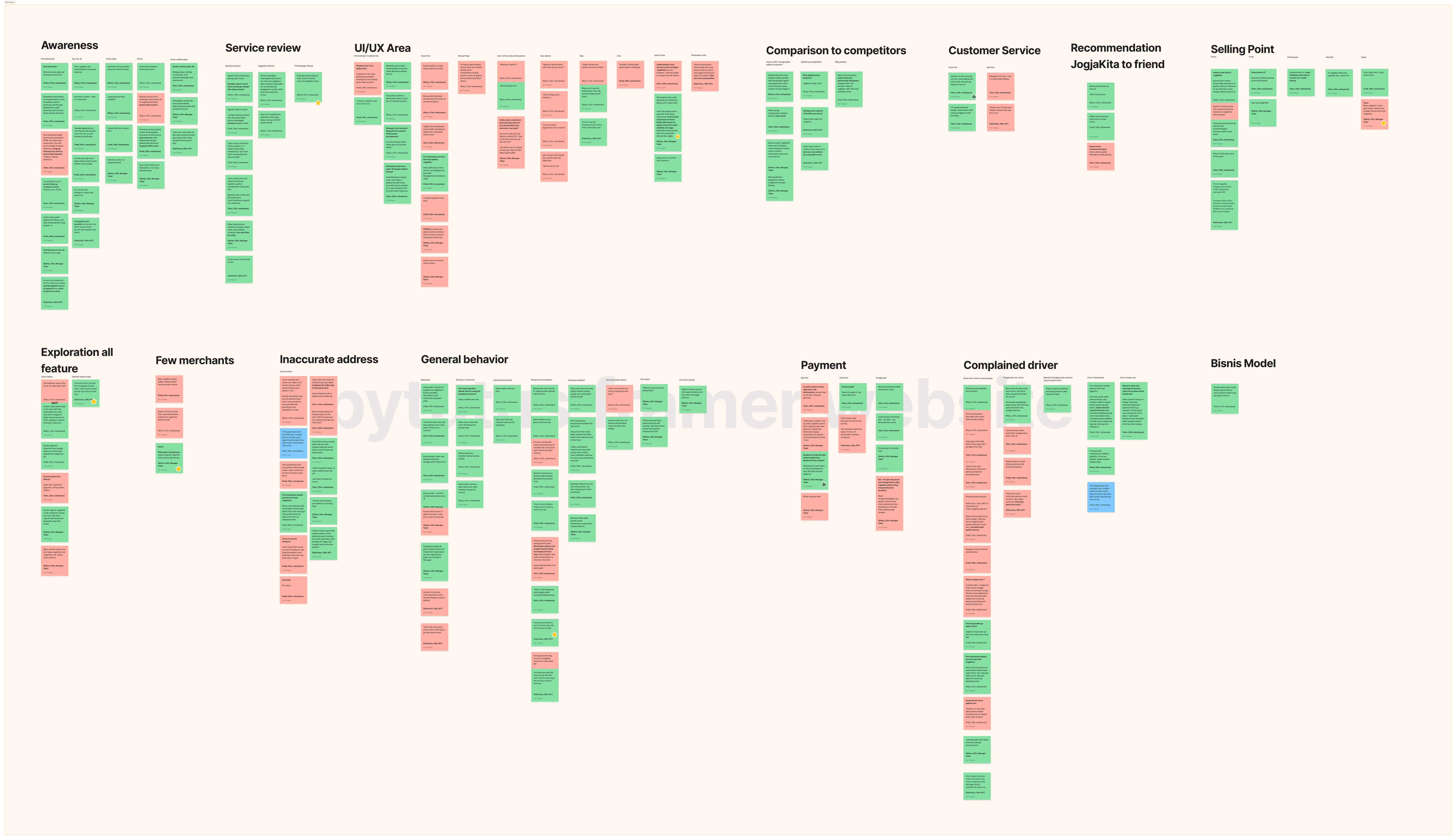
Raw Data
Data has been categorized

Together to understand the users

A. Persona
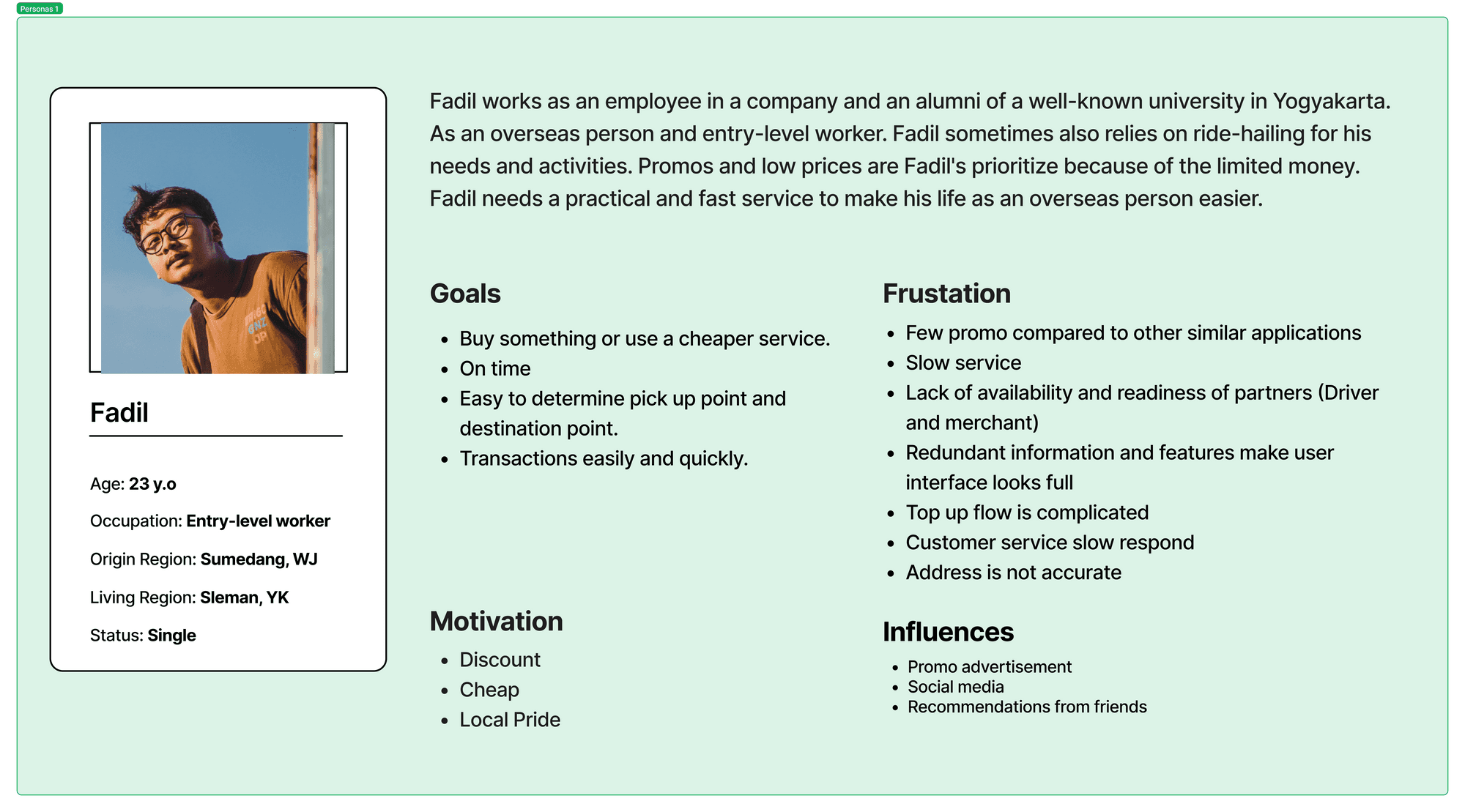
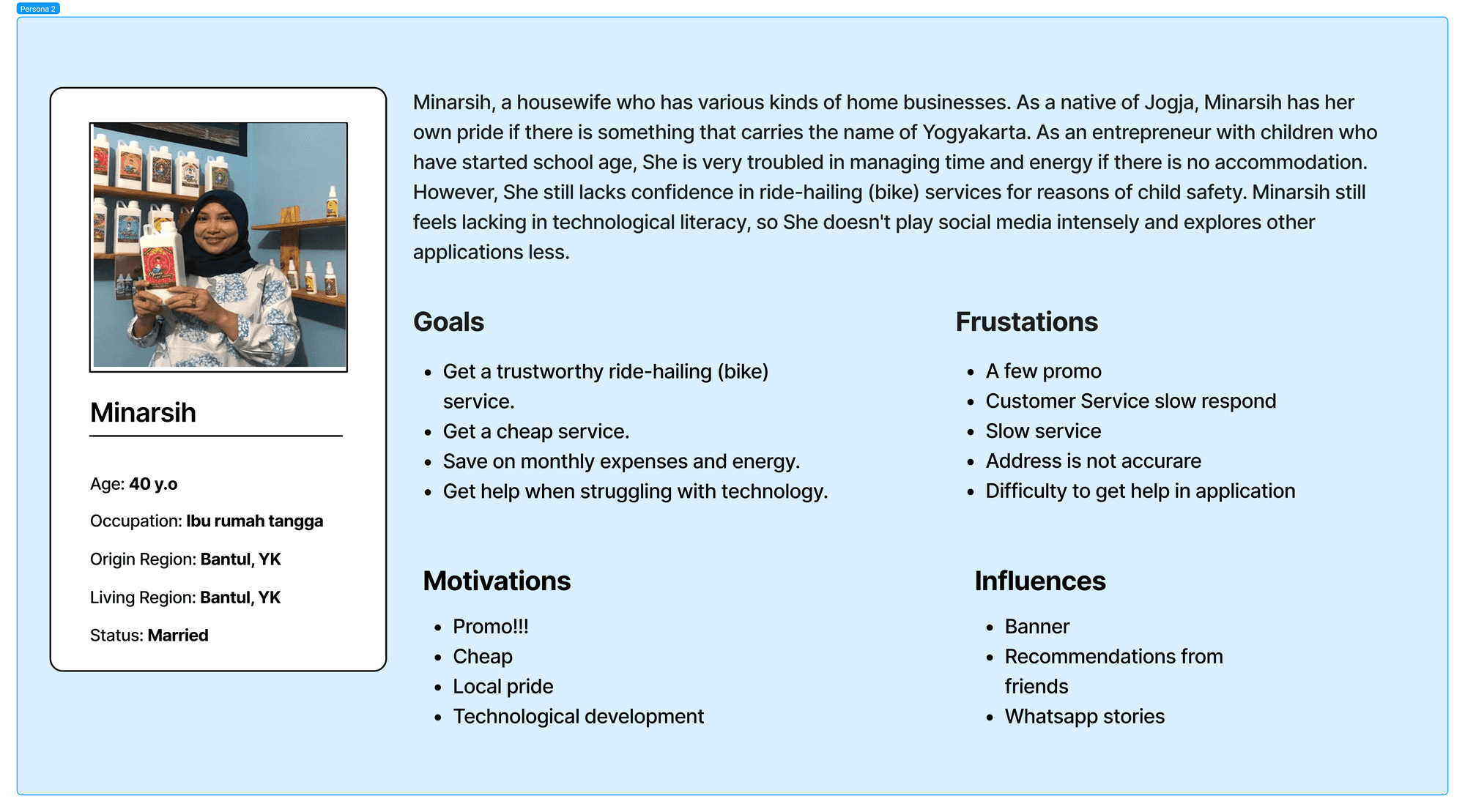
  • We identified 2 distinct personality traits, specifically users with characters aged <30 and >30.

  • Persona 1 is not the origin Jogja, but someone who has migrated to Jogja. This can be a consideration for JogjaKita to ensure the app is also friendly to the non-origin Jogja, even though it only operates within Jogja.

  • Persona 1 tends to be irritated by JogjaKita's current design and struggles to top up balances.

  • Persona 1 usually uses ride-hailing services when there are several promotions to fulfill their needs, whereas Persona 2 employs ride-hailing services when there's no transportation available while going out.

  • We identified 2 distinct personality traits, specifically users with characters aged <30 and >30.

  • Persona 1 is not the origin Jogja, but someone who has migrated to Jogja. This can be a consideration for JogjaKita to ensure the app is also friendly to the non-origin Jogja, even though it only operates within Jogja.

  • Persona 1 tends to be irritated by JogjaKita's current design and struggles to top up balances.

  • Persona 1 usually uses ride-hailing services when there are several promotions to fulfill their needs, whereas Persona 2 employs ride-hailing services when there's no transportation available while going out.

  • We identified 2 distinct personality traits, specifically users with characters aged <30 and >30.

  • Persona 1 is not the origin Jogja, but someone who has migrated to Jogja. This can be a consideration for JogjaKita to ensure the app is also friendly to the non-origin Jogja, even though it only operates within Jogja.

  • Persona 1 tends to be irritated by JogjaKita's current design and struggles to top up balances.

  • Persona 1 usually uses ride-hailing services when there are several promotions to fulfill their needs, whereas Persona 2 employs ride-hailing services when there's no transportation available while going out.

B. Customer Journey

B. Customer Journey

B. Customer Journey

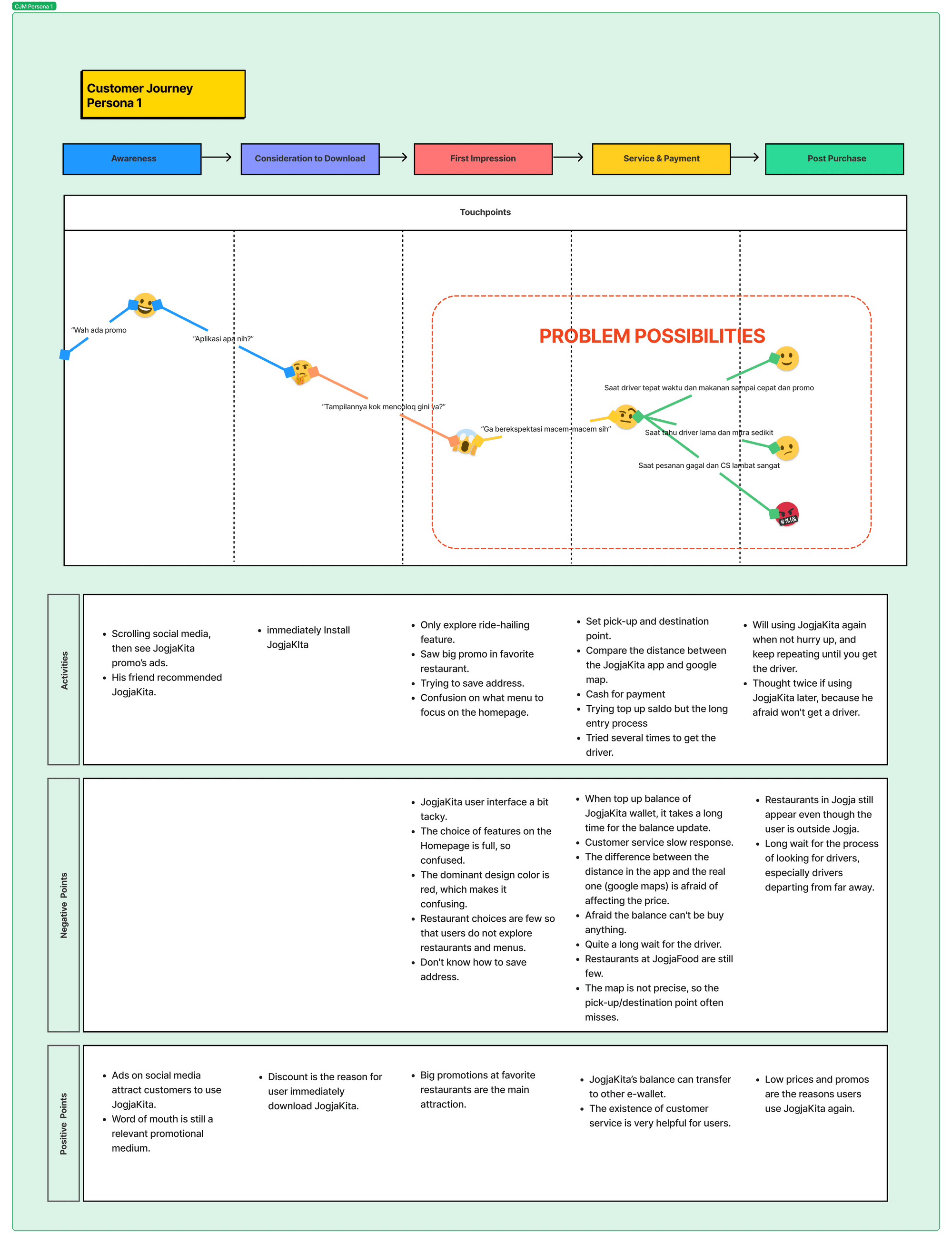
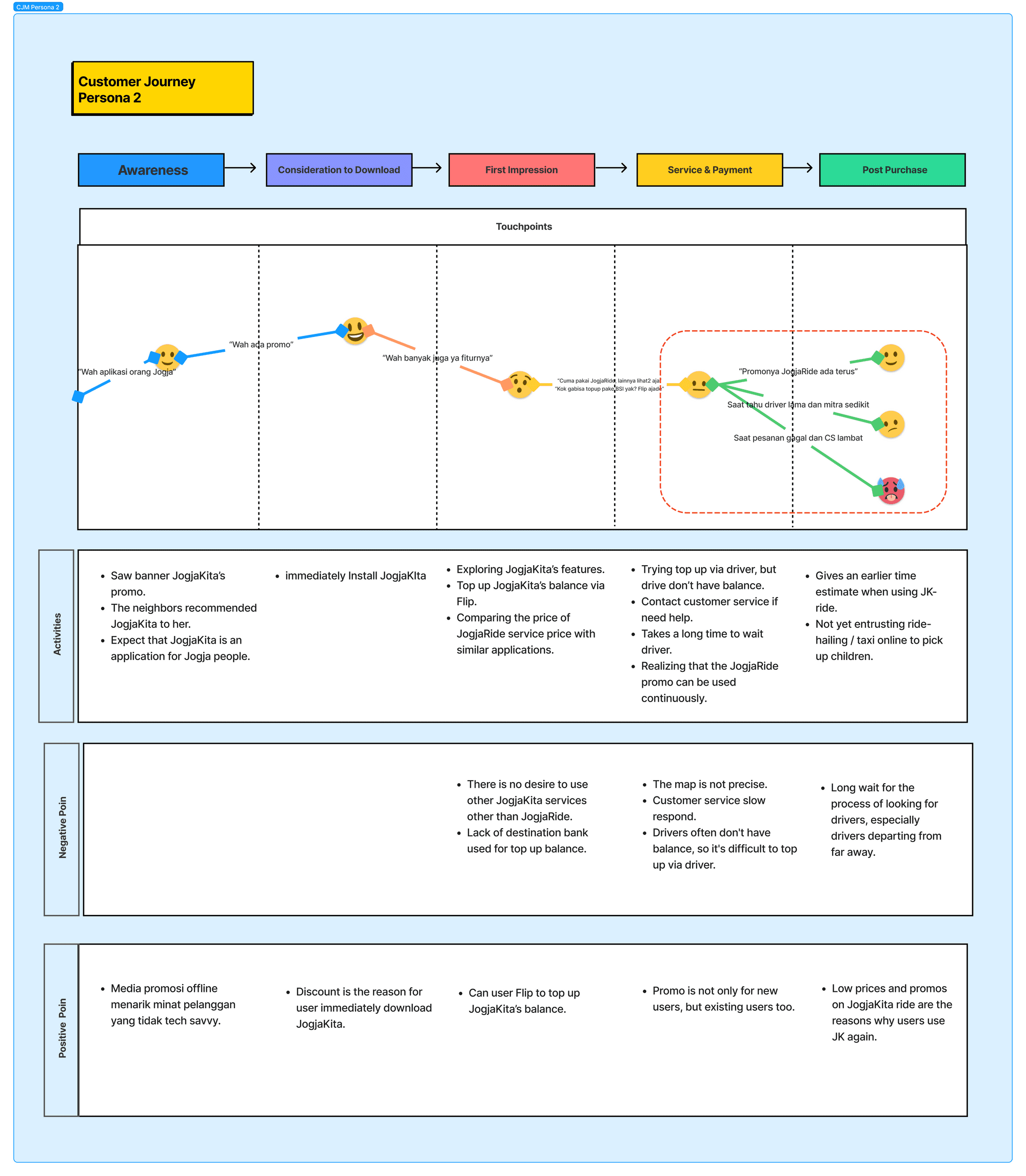
  • The most significant issue in customer journeys occurs at the service & payment and post-purchase stages.

  • Poor post-purchase experiences lead users to choose for earlier estimated times when using JogjaKita, indicating that it isn't ideal for urgent situations.

  • In the post-purchase journey stage, there are two negative user emotions and one positive one that influence the likelihood of users considering JogjaKita.

  • As a result, the presence of potential shortcomings such as limited driver partners and less responsive customer service during emergencies doesn't deter users from continuing to use JogjaKita, since they often encounter fast drivers and attentive customer service at other times.

  • Documenting both negative and positive aspects greatly assists in understanding the strengths and weaknesses present within each user journey.

  • The most significant issue in customer journeys occurs at the service & payment and post-purchase stages.

  • Poor post-purchase experiences lead users to choose for earlier estimated times when using JogjaKita, indicating that it isn't ideal for urgent situations.

  • In the post-purchase journey stage, there are two negative user emotions and one positive one that influence the likelihood of users considering JogjaKita.

  • As a result, the presence of potential shortcomings such as limited driver partners and less responsive customer service during emergencies doesn't deter users from continuing to use JogjaKita, since they often encounter fast drivers and attentive customer service at other times.

  • Documenting both negative and positive aspects greatly assists in understanding the strengths and weaknesses present within each user journey.

  • The most significant issue in customer journeys occurs at the service & payment and post-purchase stages.

  • Poor post-purchase experiences lead users to choose for earlier estimated times when using JogjaKita, indicating that it isn't ideal for urgent situations.

  • In the post-purchase journey stage, there are two negative user emotions and one positive one that influence the likelihood of users considering JogjaKita.

  • As a result, the presence of potential shortcomings such as limited driver partners and less responsive customer service during emergencies doesn't deter users from continuing to use JogjaKita, since they often encounter fast drivers and attentive customer service at other times.

  • Documenting both negative and positive aspects greatly assists in understanding the strengths and weaknesses present within each user journey.

Insight Statement

Based on user feedback, we've synthesized key insights to clarify our direction for future improvements.

Based on user feedback, we've synthesized key insights to clarify our direction for future improvements.

Insight #1: Drivers' reliability decreases when rushed.

The lack of drivers makes customers have to longer wait times and often struggle to find driver. So, customer to avoid using JogjaKita in urgent situations or when in a hurry.

Insight #2: The limited of merchants restricts customers' ability to explore and order food on JogjaFood

Customer don't explore food options in JogjaFood due to the limited merchant and distant locations of merchants, resulting in a lack of interest and fear of high shipping costs. So, customers lack of interest to buy and fear of high shipping costs.

Insight #3: The accuracy of maps within JogjaKita needs improvement.

The accuracy of maps within JogjaKita needs improvement. Customes are uncertain about shipping costs because the displayed distances often don't match those on other applications or Google Maps. So, customers find it difficult to determine pick-up and drop-off points.

Insight #4: Initial user impression of the app was considered poor

The user interface is rigid and predominantly red, making it less comfortable and causing users to struggle in focusing on their goals. Persona 1 users experience confusion on the homepage due to redundant information, so customers are challenging to prioritize or choose among different components.

Recommendation

Insight #1 through insight #3 have been provided to the related team (marketing, developer, etc) for decision-making or issue resolution. So that, my team and I focused on offering recommendations in the UI/UX area :

Enhanced Homepage by considering user experience that felt overwhelmed, cluttered, and unfocused. So that:

  1. Minimize red hue/color in the interface and banners.

  2. Organize PPOB service.

  3. Refresh icons to better reflect functionalities and a modern feel.

Enhance the homepage by reducing redundant information, allowing users to easily focus and prioritize information. So that:

  1. The PPOB functionality isn't required in the nav bar; instead, a category element is established on the Home page.

  2. A single shortcut to the promo/voucher page .

Improve the JogjaRide, JogjaKurir, JogjaCar checkout pages, considering the inconsistencies in how to apply promos for each service, thus make different expectations for users. Also, address the user experience issue of navigating between the promo and checkout pages. So that:

  1. Implemented the option to input promo/voucher codes at the checkout page.

  2. Disable promo/voucher that are not applicable at the checkout stage, so users are aware of the unusable promos.

  3. Continue to preserve the method for selecting a promo, which is by directly choosing from the available promo vouchers.


Generative study: To know the JogjaKita’s user behavior and problem

Generative study: To know the JogjaKita’s user behavior and problem

© Bariyatus Diyah Nurlaili 2024